Tour de France Femmes 2026: Route
First published 5 december 2025 - last updated on 31 July: weather forecast Grand Départ added
Race dates: Saturday 1 August – Sunday 9 August
Race type: Grand Tour
Key stages: 4, 5, 7 and 10
Favourites: Demi Vollering, Pauline Ferrand-Prévot, Anna van der Breggen, Paula Blasi
Defending champion: Pauline Ferrand-Prévot
Record holders: Pauline Ferrand-Prévot, Kasia Niewiadoma, Demi Vollering and Annemiek van Vleuten (1 victory each)
Stage-by-stage guide: Tour de France Femmes 2026
[click on the italicised links for full stage previews]
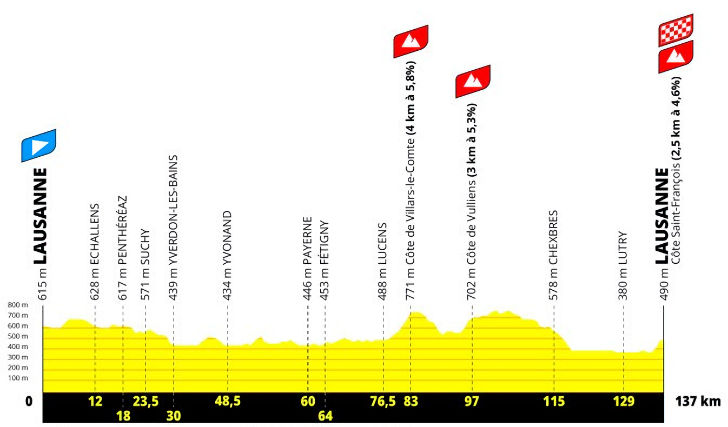
Stage 1 – 138.0 kilometres, 1,700 metres of elevation gain
The opening stage of the Tour de France Femmes begins and ends in Lausanne. The route heads north in a loop past Lake Neuchâtel and features three climbs. The finish is set on the Place Saint-François, atop a 2.6-kilometre ascent averaging 4.6%.
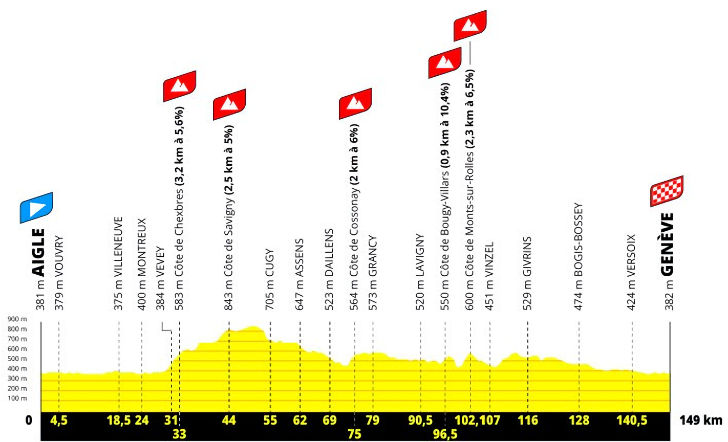
Stage 2 – 147.9 kilometres, 1,800 metres of elevation gain
On day two, the race caravan travels from Aigle to Geneva. Despite a hilly middle section featuring a succession of climbs, the route appears well suited to the sprinters, as the final ascent comes a long way from the finish.
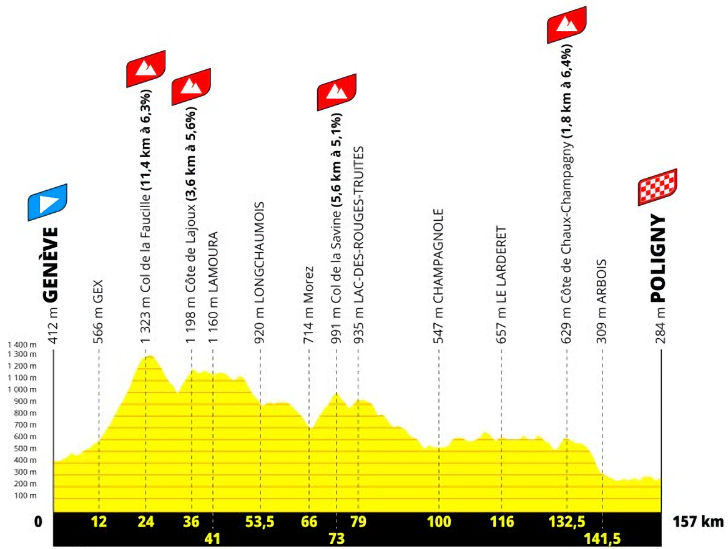
Stage 3 – 156.5 kilometres, 2,500 metres of elevation gain
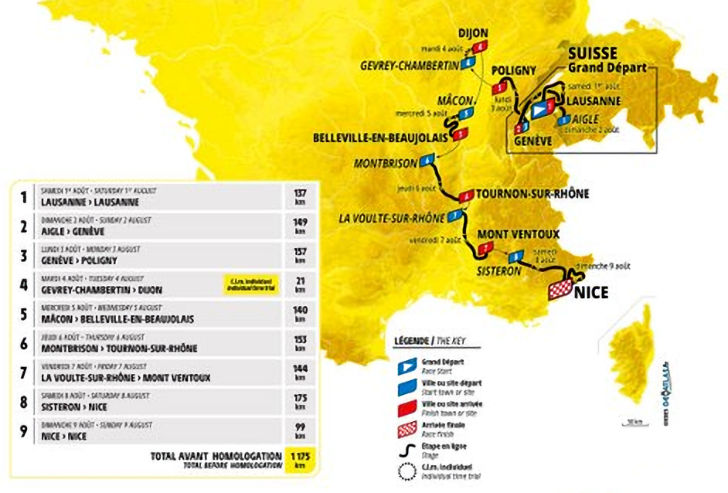
Stage 3 sees the Tour cross into France. Starting in Geneva, the route winds through the Jura Mountains en route to Poligny. After a long early climb and a rolling middle section, the riders descend into flatter terrain halfway through the stage, while a descent 24 kilometres from the finish marks the beginning of the flat finale.
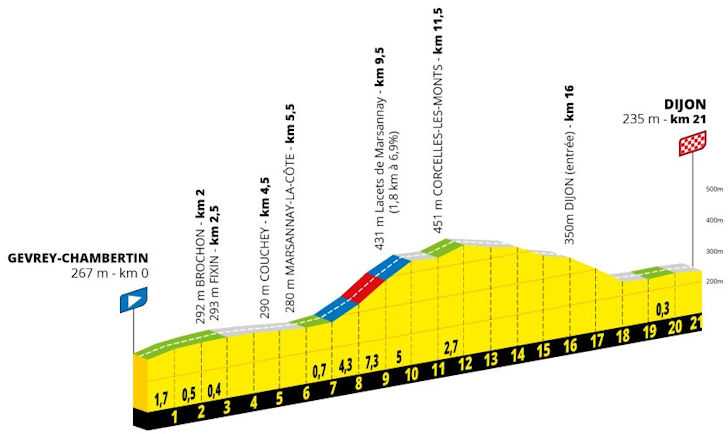
Stage 4 – 21.0 kilometres, 255 metres of elevation gain
After being omitted from last year's race, the individual time trial returns to the Tour de France Femmes. The riders set off at intervals from Gevrey-Chambertin to Dijon, tackling a 3-kilometre climb at 5.7% just before halfway. Following a rolling section and a descent, the stage concludes with a flat run-in to the finish.
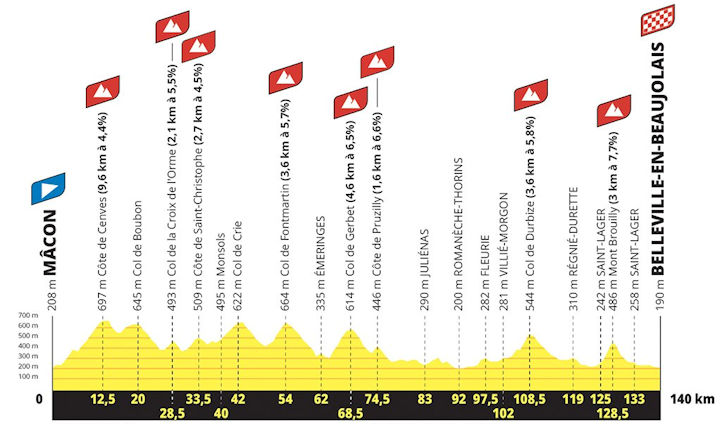
Stage 5 – 140.0 kilometres, 2,900 metres of elevation gain
Although both Mâcon and Belleville-en-Beaujolais are located in the Rhône Valley, the terrain in between is anything but flat. The riders head into the hills west of the river, with the decisive section coming in the final 35 kilometres, where the Col de Durbize (with gradients of up to 16%) and the punchy Mont Brouilly await. The latter averages 7.7% over 3 kilometres, and from its summit there are still 10.6 kilometres to go.
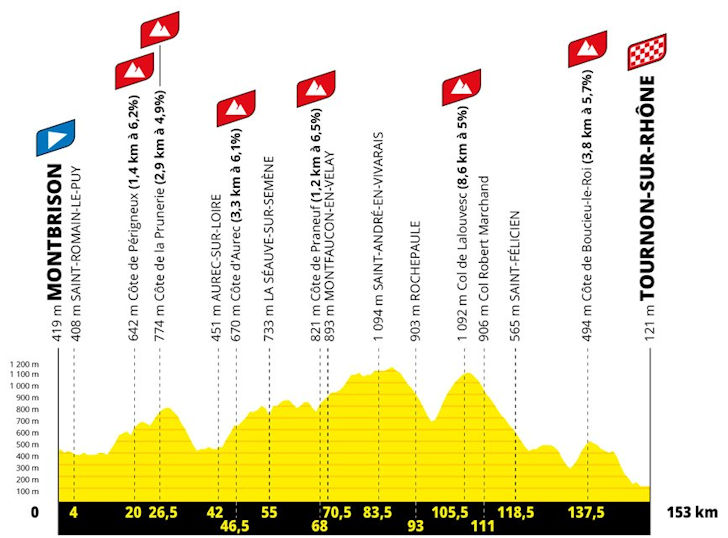
Stage 6 – 153.4 kilometres, 2,600 metres of elevation gain
From stage six onwards, the Tour heads south. In terms of climbing difficulty, the route is similar to the previous stage, albeit a slightly easier version. Another notable feature is that the final 50 kilometres are predominantly downhill. The stage starts in Montbrison and travels through the Ardèche before finishing in Tournon-sur-Rhône.
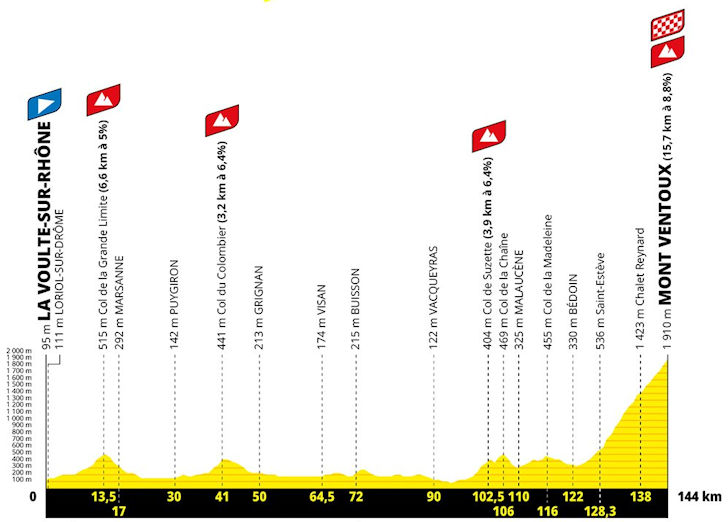
Stage 7 – 146.8 kilometres, 3,500 metres of elevation gain
The queen stage is scheduled for day seven. After climbing for 15.6 kilometres at an average gradient of 8.8%, the riders will reach the finish atop Mont Ventoux. It will be the first time that the Giant of Provence features in the Tour de France Femmes. The rolling and hilly approach alone already accounts for a hefty 2,000 metres of elevation gain.
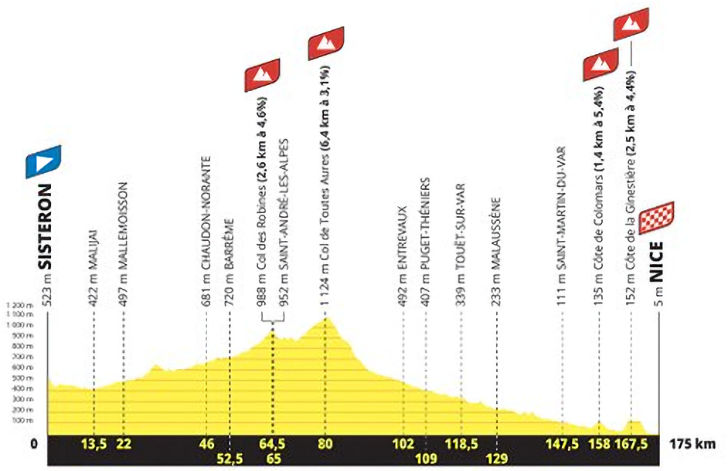
Stage 8 – 171.9 kilometres, 1,420 metres of elevation gain
The longest stage of the Tour de France Femmes also features the least climbing. On paper, that would suggest a bunch sprint, although two short climbs in the final 18 kilometres could prove too much for some of the fast women. The stage starts in Sisteron and finishes in Nice.
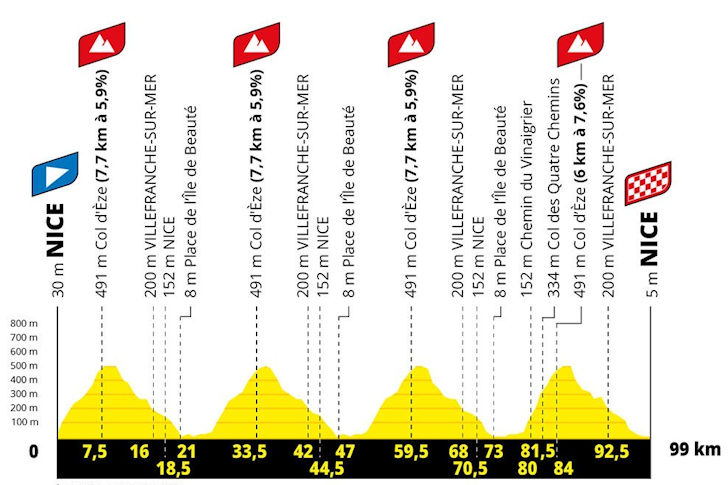
Stage 9 – 99.2 kilometres, 2,100 metres of elevation gain
The final stage takes the form of a four-lap circuit in the hills east of Nice, with the Col d'Èze providing the key challenge. The riders tackle the climb on every lap, but the decisive ascent comes on the final passage, when they take on its steepest side: 6 kilometres at an average gradient of 6.7%, including a brutal third kilometre at 12.2%. From the summit, a fast 16.8-kilometre descent leads to the finish on the Promenade des Anglais.
Weather forecast for the Grand Départ:
The Swiss Grand Départ of the Tour de France Femmes is set to take place under sunny skies, with temperatures reaching the high thirties in some places. Around 30°C is expected at the start in Lausanne, while the riders can look forward to even hotter conditions on stage 2 from Aigle to Geneva, where temperatures could climb to 35°C.
With barely any wind forecast, the expected puncheurs' showdown on the opening day and the likely bunch sprint on stage 2 should unfold without any significant interference from the weather.
Tour de France Femmes 2026: routes, profiles, videos
Click the images to enlarge



Comment
5 comments
Brian patrick
Why are there no gpx files of the tdff yet?
WALLY PHAIR
We arrive in Evian les Bains, Aug. 15, missing the start in Lausanne, by two weeks, but will be in Saint Romain en Viennois as the Femmes pass through the village on Aug. 7, with our friends and hosts from Vancouver Canada. As also missed the mens final in Paris by 4 days, so excited to see the Femmes.
Glen Jamrath
Looking forward to follow some of the stages live. Will be in Lausanne and follow the Grand Departure in Lausanne, Aigle and Geneva. Hope to see a couple of stages in France too.
Ane
Hi, does anyone know where to find gpx files of the routes for this year or if they will be available here anytime soon? Thanks
Harmen Lustig
We will publish the gpx files in the course of this week.